

In the first half of this year, a cross-border seller specializing in apparel posted impressive results.
Sales grew by 40% year-on-year, order volumes climbed steadily, and the store's ranking improved continuously. Logically, as the business expanded, profits should have risen in tandem.
However, after the month-end financial reconciliation, the seller discovered that profits had fallen short of expectations. After a lengthy review with the finance team, the culprit was identified: returns.
While sales had surged, so had the volume of returns. Many return requests expired before they could be processed, forcing the seller to issue refunds without receiving the goods back. Furthermore, returned items required reprocessing before they could be relisted: some needed quality checks and re-labeling, others required new packaging, and some had been used and had to be destroyed.
Logistics, warehousing, labor, inspection, re-labeling, disposal—none of these costs seemed high in isolation. Yet, as the volume of returns mounted, these fragmented expenses coalesced into a significant financial burden. No matter how high the profit margins, the business could not sustain such a drain.
The hotter the market, the more critical the issue of returns becomes.
Global cross-border e-commerce continues to show strong growth momentum heading into 2026.
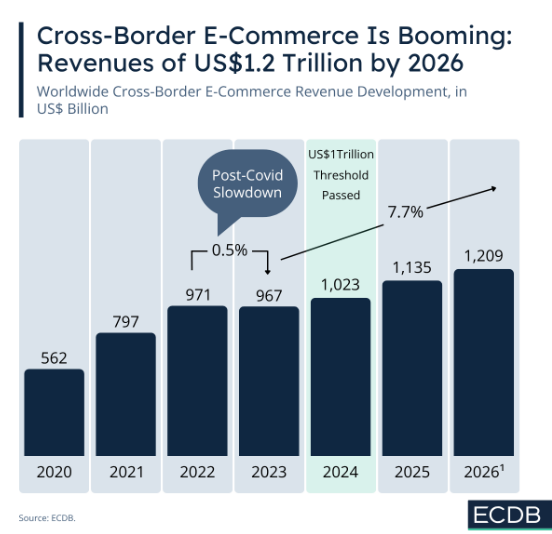
Image source: ECDB
Industry research firm ECDB forecasts that global cross-border e-commerce market revenue will surpass $1.2 trillion by 2026. Although the industry underwent a brief adjustment in 2023—with market size dipping to $967 billion—it rebounded past the $1 trillion mark in 2024, maintaining a steady overall growth trend. Even policy shifts, such as the US eliminating the *de minimis* exemption for small-value shipments and raising tariffs on certain imports, have not altered the trajectory of continued global cross-border e-commerce expansion.
A rising number of orders is typically cause for celebration. However, for sellers, there is another set of figures that demands equal attention.
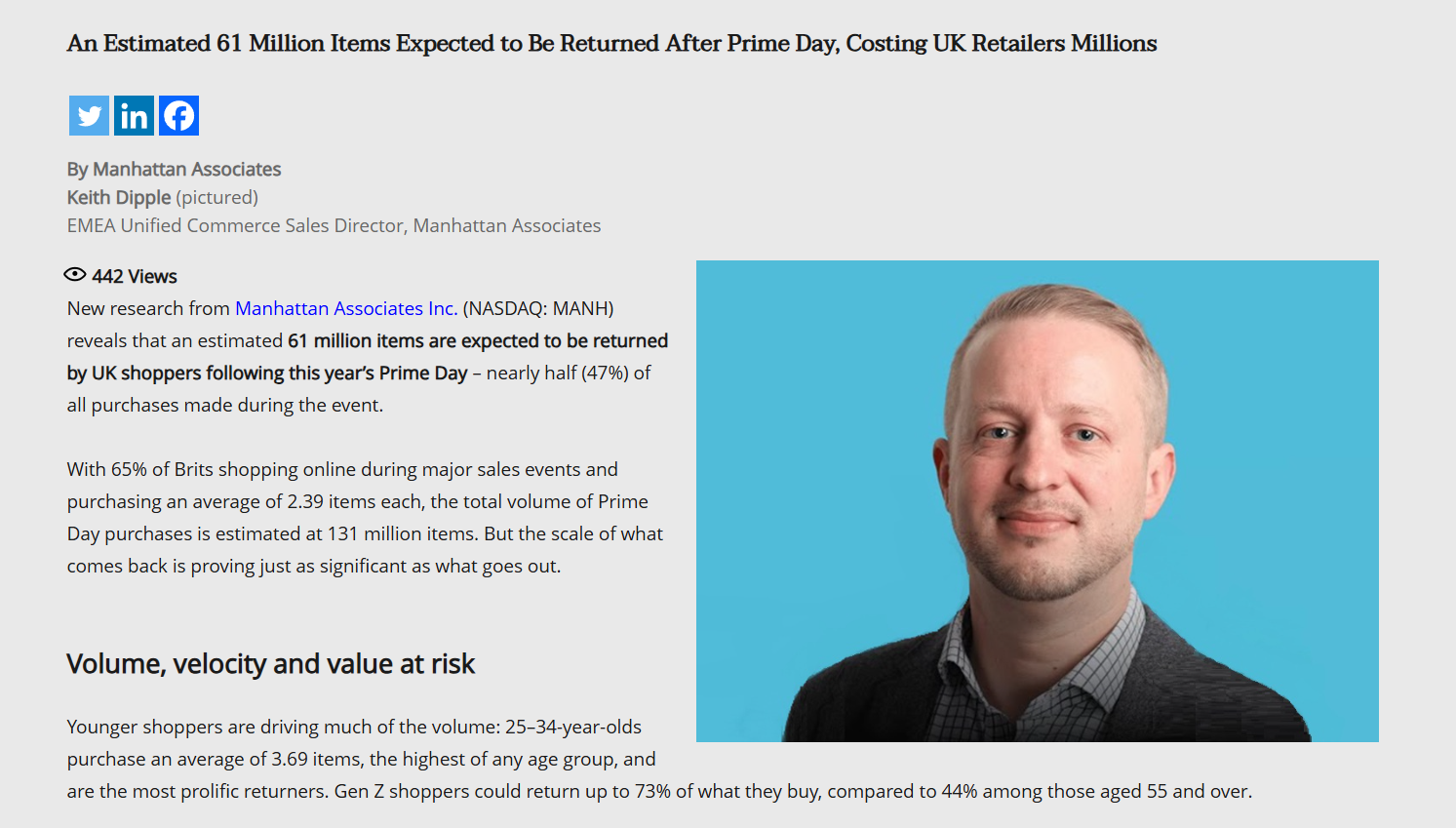
Image source: Manhattan Associates
According to recent research by Manhattan Associates, a provider of supply chain and omnichannel fulfillment solutions, UK consumers were expected to return approximately 61 million items following this year's Prime Day—representing 47% of the roughly 131 million items purchased during the event.
In other words, for nearly every two items sold, one was likely to enter the return process. Although relevant statistics for the US market have not yet been released, given that the US e-commerce market is far larger than the UK's, the pressure regarding returns during Prime Day is bound to be even more intense.
At this point, many sellers likely share the same sentiment: the issue isn't the returns themselves, but rather the fact that returns are mounting while the actual financial loss remains unknown. Many sellers handle returns daily without ever truly calculating the associated costs.
How much does a single return from an overseas consumer actually cost?
When returns are mentioned, most sellers immediately think of shipping fees. However, the true cost of an overseas return goes far beyond the price of a shipping label.
The process involves multiple stages, spanning from the moment the consumer initiates the return to the final disposition of the item.
Goods must be returned to an overseas warehouse; staff must handle receipt, registration, and quality inspection; decisions regarding repackaging, relabeling, or refurbishment must be made based on the item's condition; and eligible items are restocked for sale, while ineligible ones may require destruction or consolidated transshipment.
In addition to these, there are costs for storage, manual processing, and secondary delivery, as well as hidden costs arising from inventory backlogs and product depreciation.
When calculating operational data, many sellers account only for the refund amount, overlooking these subsequent processing costs. Consequently, while profits may look healthy on paper, the actual bottom line is gradually eroded.
Moreover, costs vary significantly depending on the country, product type, and chosen handling method. For a returned item, is it more cost-effective to destroy it immediately or to relabel and resell it? Should it be restocked locally or shipped back to the home country in bulk? Many sellers lack a clear answer to these questions.
If costs cannot be accurately calculated, making the optimal decision regarding how to handle returns becomes difficult.
To bring transparency to return costs, U-Speed has developed a handy tool.
Drawing on our extensive experience serving cross-border sellers, we’ve found that many clients ask the same question before inquiring about overseas return solutions: "How much will this return actually cost?"
Yet, there is no single, fixed answer to this question.
This is because return costs are influenced by a multitude of factors, including the sales destination, order volume, return volume, product value, and the chosen handling method. Different sellers—or even the same seller at different stages of their business—may encounter vastly different outcomes.
To address this, we turned the calculation logic we use when designing return strategies for clients into a WeChat Mini Program: the "U-Speed Overseas Return Assistant."

It is simple to use. Sellers need only input their monthly sales volume, average order value, and monthly return volume, then select the target market (e.g., the US or UK). The Mini Program then instantly estimates the annual return volume and potential financial losses based on market-specific conditions.

For instance, imagine a store with 1,000 monthly orders, an average order value of $50, and 100 monthly returns. The Mini Program automatically calculates the projected annual return volume and estimates the associated financial loss.
Many sellers have a common realization at this point: they are surprised to see just how much profit is "eaten up" by returns over the course of a year.
But more importantly, this is just the first step. Many sellers know they are losing money but are unaware of more cost-effective ways to handle returns.
Therefore, after calculating the potential losses, the Mini Program provides cost references for U-Speed’s various return handling solutions.

For example, sellers can view the specific details of two service tiers: "Express Quality Inspection" and "Standard Quality Inspection."
Express Quality Inspection covers basic operations such as receiving, inventory counting, visual product checks, close-up photos of defects, and repacking. Standard Quality Inspection builds on this by adding package photography, allowing sellers to further verify the product's condition and providing a basis for decisions regarding resale, relisting, or after-sales handling.
Once a service is selected, the Mini Program performs another crucial calculation: estimating the annual cost savings achieved by using U-Speed’s overseas return warehouse.
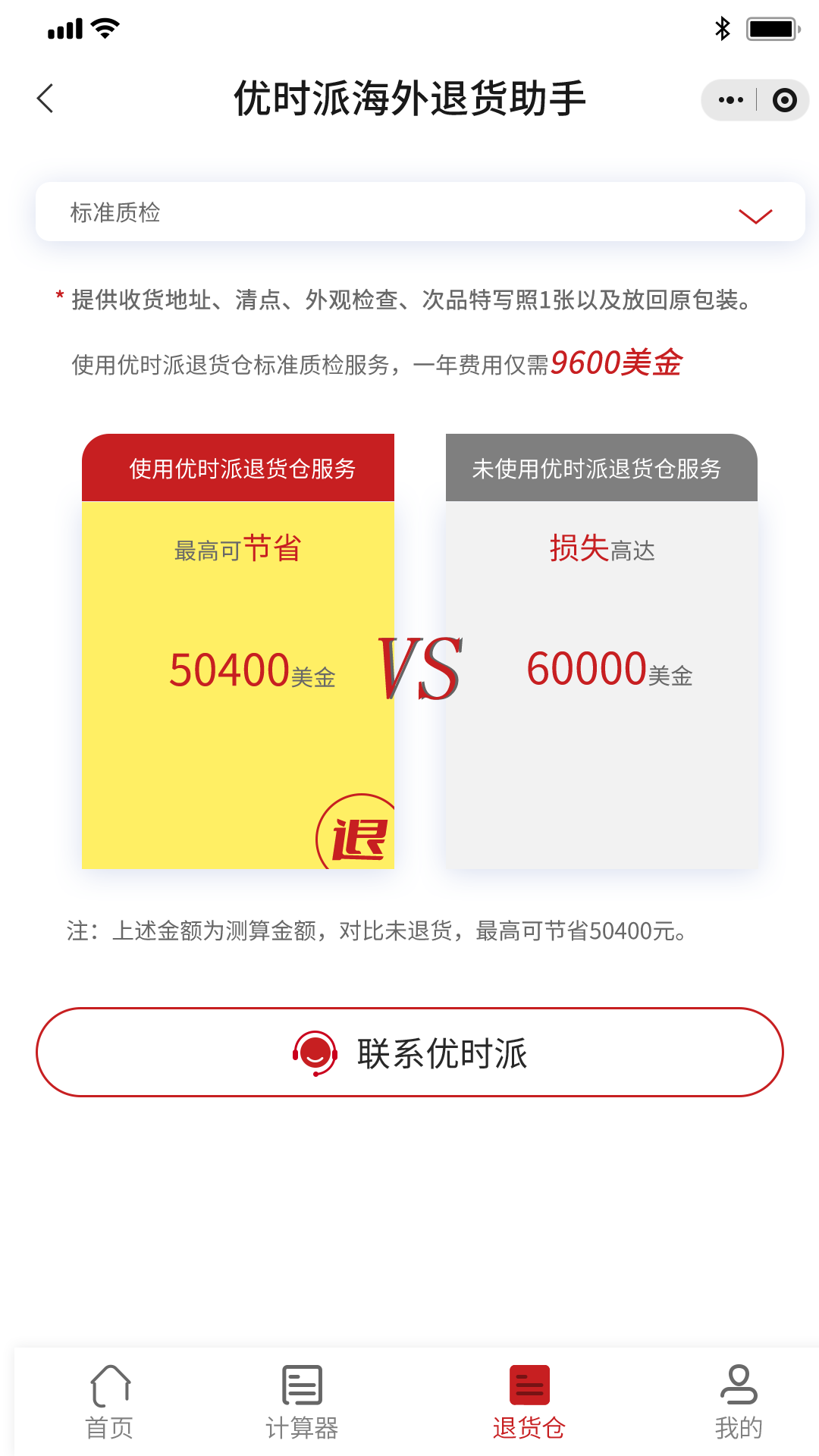
In the example scenario, using U-Speed’s Standard Quality Inspection service costs approximately $9,600 annually; compared to handling returns in-house or simply discarding the goods, this approach could reduce losses by up to $50,400.
For sellers, this result isn't about promising a specific amount of savings. Instead, it uses clear, intuitive data to demonstrate the significant impact that different return handling methods can have on the bottom line. Accurately calculating costs is merely the beginning; actually reducing them is what truly matters.
Of course, simply knowing the cost does not mean the problem is solved. For cross-border sellers, the real priority is implementing a smarter returns strategy to minimize losses on every returned item and unlock renewed value from the merchandise.
As a service provider specializing in global returns, U-Speed has established a network of overseas return warehouses across Europe and the Americas. We offer cross-border sellers a comprehensive, one-stop solution that covers everything from receipt and quality inspection to photo reporting, relabeling, repackaging, repair and refurbishment, resale, and disposal.
We hope that U-Speed’s overseas returns tools will help more sellers clearly calculate their costs, and that our overseas warehouses will enable them to genuinely lower those costs—ensuring every order generates maximum value.

