

For cross-border footwear sellers, high heels have always presented a unique challenge in terms of return management.
Consumers often request returns for reasons such as incorrect sizing, the fit not meeting expectations, or dissatisfaction with the color or style. In many of these cases, the products themselves are free of quality defects; the return simply stems from the consumer's decision after trying them on.
The difficulty lies in determining whether a returned pair of high heels is still suitable for resale—a judgment that cannot be made based solely on the return reason provided on the platform.
Are there scratches on the upper? Is there visible wear on the sole? Is the heel intact? Is the shoebox crushed or deformed? Are the tags and accessories all present? Answering these questions requires someone on-site to unpack, inspect, and photograph the items, and then decide on the appropriate next steps based on the actual condition.
Recently, a cross-border seller specializing in women's high heels—a client of U-Speed—encountered precisely this challenge.

Client Pain Point: Difficulty handling consumer returns and mounting pressure on return management
This client sells women's high heels primarily to the US market, receiving over 100 returned orders each month. As the business has expanded, the volume of returns has steadily increased.
The client realized that the real operational strain stemmed not from the sheer number of returns, but from the lack of a standardized, professional process for handling them.
Return packages from different platforms were sent to various locations without a unified return address, and return information was often not updated in a timely manner, making it difficult for the seller to track the status of each return immediately. More importantly, because the team was based domestically, they could not visually assess the actual condition of the goods and had to rely on the return reasons listed on the platforms.
However, while the platform's return reason explains why a consumer returned an item, it does not indicate whether the product remains sellable.
For high heels, even a minor scratch, slight sole wear, or a slightly deformed shoebox can impact the product's value. Without professional inspection of each item, many products that could have been resold might end up being classified as unsellable inventory, resulting in unnecessary financial loss. Instead of rushing to process returns, U-Speed first established a set of inspection standards.
After gaining a deep understanding of client needs, U-Speed realized that the key to this project wasn't the speed of receipt, but rather the meticulousness of the inspection and the consistency of the standards applied.
Tailoring its approach to the specific characteristics of women's high heels, U-Speed developed a standardized inspection process. Returned items are consolidated at U-Speed’s U.S. returns warehouse; upon receipt, packages are signed for and logged into the system within 24 hours, ensuring every return is quickly brought under management.
Staff then inspect the condition of the items against uniform standards. Checks cover the uppers (looking for stains, scratches, indentations, or creases), soles (checking for wear from use), heel stability, and the integrity of the shoe box. They also verify the completeness of tags, dust bags, and accessories, while cross-referencing left/right shoes and SKU information to prevent mix-ups or shipping errors.
With high heels, every detail influences how the product is subsequently handled; therefore, the inspection process requires not only meticulous attention to detail but also strict adherence to standardized criteria.
Visual feedback enables clients to make accurate assessments from afar.
Many sellers have encountered this scenario: a warehouse reports "no issues with the product," yet upon actual receipt, the seller discovers a deformed shoe box or significant wear on the soles.
To address this, U-Speed photographs key areas—such as the uppers, soles, shoe boxes, and accessories—during the inspection and shares these images alongside the results with the client.
Unlike relying solely on text descriptions, this visual feedback offers clients an intuitive view of each pair's actual condition, allowing them to quickly decide on the next steps: which items can be resold immediately, which require repackaging or tidying, which are suitable for stock reallocation, and which need special handling.
For cross-border sellers, this approach not only boosts processing efficiency but also brings greater transparency to the returns management process.
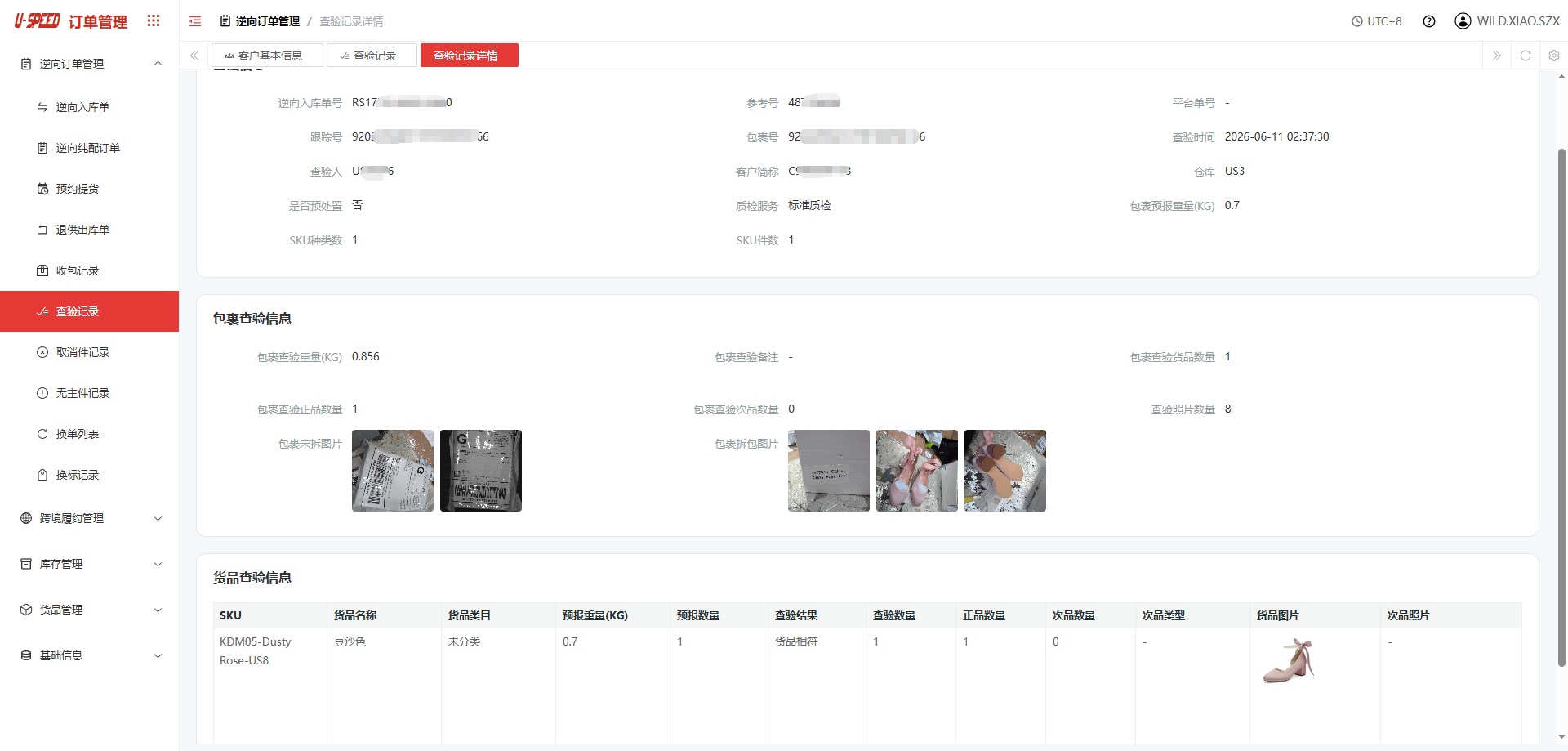
Giving every valuable pair of shoes a chance to return to the market.
Following inspection, items that meet sales criteria undergo tasks such as shoe box refurbishment, accessory reorganization, repackaging, and SKU classification—all performed according to client specifications—to prepare them for resale. Throughout the process, U-Speed does not simply categorize returned items as "salable" or "unsalable"; instead, it classifies and processes them based on their actual condition, enabling clients to manage their inventory more effectively.
After a period of collaboration, this standardized process began to yield tangible results. In this specific case, approximately 95% of the returned women's high heels were successfully reintroduced into the sales channel. For the client, this meant that a significant volume of goods—which might otherwise have been liquidated at low prices or discarded due to a lack of visibility regarding their condition—was restored to inventory, thereby minimizing the financial loss associated with returns.
High-Value Goods Demand Professional Return Handling Capabilities
For products like women's high heels, managing returns involves more than just receiving and warehousing; it requires a reassessment of the product's value.
A professional return handling process not only helps sellers accurately gauge the condition of returned items but also allows more salable products to re-enter the market, reducing inventory waste and maximizing value recovery.
U-Speed specializes in cross-border e-commerce return services. We currently support a wide range of categories—including footwear, apparel, home goods, consumer electronics, and small appliances—by providing services such as return receipt, quality inspection, photo-based reporting, sorting, processing for resale, and overseas warehousing. We tailor return handling solutions to the specific characteristics of each product, helping cross-border sellers manage their overseas return inventory with greater efficiency.
While returns are inevitable for cross-border sellers, the ability of each returned item to continue generating value depends on the presence of a professional and efficient return handling system.

